Call for participation
- A. Janz
- Consulting , Data , RDM , HPC , Data Science , Artificial Intelligence , Machine Learning
- June 24, 2024

Alicia Janz
I have a background in linguistics with a specialization in phonetics. Prior to joining the DKZ.2R I studied verbal and multimodal feedback in conversation with a focus on intonation and conversational context. In December of 2023 I started working for Forschungszentrum Jülich where I am currently the main project coordinator for the DKZ.2R. To contact me or my colleague Katharina Immel you can send an e-mail to: info[at]dkz2r.de.
Call for participation!
The Data Literacy Center Rhine-Ruhr (DKZ.2R) issues a call for participation in its “rent-an-expert” project! We offer support for ambitious research projects of PhD students and early postdocs dealing with Data Science and Artificial Intelligence, High Performance Computing and Simulation, and Research Data Management. As the DKZ.2R is funded by the German Federal Ministry of Education and Research (BMBF) as well as the EU, this offer is free of charge!
What is the DKZ.2R?
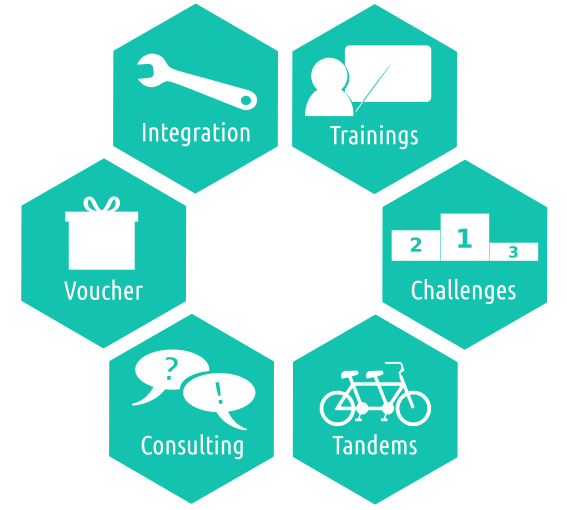
The DKZ.2R aims to reduce data-related hurdles in research by supporting scientists in improving their methodological data-related skills. We are a consortium of nine institutions in the Rhine-Ruhr area, including universities, research institutions, and universities for applied science. One of the main goals of the DKZ.2R is to identify and connect different projects and efforts to support scientists in their work with research data. To this end, we connect researchers directly, foster their collaboration, and aid using resources as efficiently as possible.We currently establish different support structures including research consulting via research tandem projects and informal gatherings like Data Cafés and hackathons. Our “rent-an-expert” project offers short- or long-term support by expert consultants from the fields of e.g. Machine Learning, Research Data Management, and High Performance Computing.
What we are looking for:
We invite applications from all early-career researchers (PhD students, early postdocs, masters’ students in special cases) who are planning or already working on a project in which they are facing data-related hurdles. We are especially, but not exclusively, looking for projects in life sciences, natural and engineering sciences, mathematics, and supercomputing. Anyone to whom scientific consulting could be beneficial is encouraged to apply!
What we are offering:
Each chosen applicant is offered an introductory meeting (around two hours) in which the applicant and consultant get to know each other. Here, the applicant also introduces the (planned) project and describes the data-related problem and expected or encountered difficulties. Furthermore, this meeting will be used for the applicant and consultant to align their project-related expectations and to determine whether long-term support is viable. There could be different short-term and longer-term consulting scenarios. Some example scenarios are illustrated in the following:
Scenario 1, short-term consulting: With an existing implementation for processing data, performance metrics deteriorate or fundamental runtime problems occur when the data volumes under consideration are expanded. The DKZ.2R consultants can help to identify and localize the causes and provide initial indications of a solution (e.g., by suggesting alternative Deep Learning architectures or GPU-parallelization approaches) .
Scenario 2, longer-term consulting: The processing of large amounts of data requires concepts and algorithms that enable an implementation and efficient execution in a high-performance environment. DKZ.2R consultants provide support in the concept development phase and assist applicants in the implementation phase.
Ultimately it is up to you and your consultant to decide for how long and in what frequency you would like to be supported in your project.
Application requirements:
All applications must be submitted in PDF format via e-mail (subject: “Application Scientific Consulting’’) to info@dkz2r.de by August 5, 2024, 5 p.m. (UTC+2). Applications must be written in Times New Roman, 12pt. (or equivalent) with a line spacing of 1.5. The applications should be 1–1.5 pages long and must include the following information:
- A short description of the (planned) scientific project and its planned duration. How is data literacy particularly relevant in this project? Does the applicant receive any financial funding or non-material support for the project?
- Up to six keywords describing the (planned) scientific project.
- The applicant’s background such as education, current position, and scientific domain, as well as a short summary of the applicant’s data-related skills in relation to the project.
- The applicant’s ideas on how they potentially wish to be supported by a scientific consultant. Do you anticipate long- or short-term consulting? Does the project consist of different phases that might influence the frequency of the consulting? How specifically can a consultant support the project?
By submitting an application you agree that published material based on the cooperation with DKZ.2R will contain an acknowledgement and that a short report about your project will be submitted when the cooperation/project has concluded. Feel free to share this call with anyone who might be interested! For questions please check our website www.dkz2r.de or send us an e-mail at info@dkz2r.de.