A Survival Guide to Research Data Sharing Services in the Rhine-Ruhr Region
- A. Janz
- Data , RDM , Data Sharing
- October 14, 2025

Alicia Janz
I have a background in linguistics with a specialization in phonetics. Prior to joining the DKZ.2R I studied verbal and multimodal feedback in conversation with a focus on intonation and conversational context. In December of 2023 I started working for Forschungszentrum Jülich where I am currently the main project coordinator for the DKZ.2R. To contact me or my colleague Katharina Immel you can send an e-mail to: info[at]dkz2r.de.
A Survival Guide to Research Data Sharing Services in the Rhine-Ruhr Region
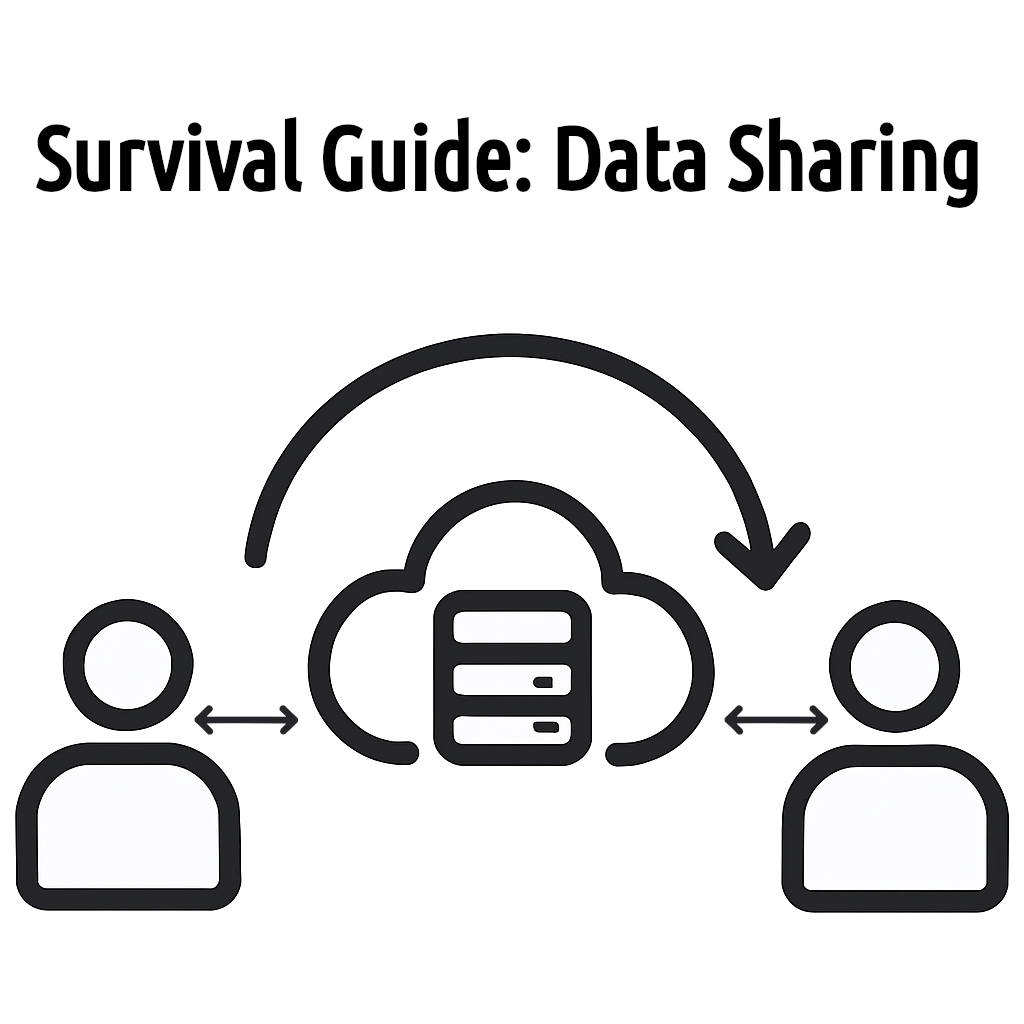
There are a lot of reasons why collaborating with other researchers on scientific projects is great! It provides new perspectives and gives you the chance to benefit from other people’s knowledge and input. When it comes to sharing and exchanging data across multiple locations and devices however, researchers are often disoriented and don’t know which tools, cloud services and so on are safe to share data in a secure and ethical way.
For example: did you ever aim to share your research data with colleagues or collaborators and ended up exchanging a flash drive or uploading it to a cloud provider without really knowing where the service is hosted, how secure it is and how the provider might use (or even sell) your data? I’m pretty sure I have (I am not proud of it) for lack of knowledge and time to research better alternatives.
So this post is for everyone who is as convinced as I am that collaboration is the way to go to enable excellent research and that research data deserves to be shared using trustworthy tools.
In the following text you will find an overview of data sharing tools offered i.a. by universities, information on who can use or access them and which kinds of data one should or should not share using these tools.
We also gathered some red flags for data sharing tools which you can use to estimate how safe or unsafe e.g. the cloud provider you like to usually use is to share certain kinds of data.
First things first:
Why can’t we just share data via flash drive? Exchanging data via flash drive is not ideal for a variety of reasons.
Here are the most important ones:
- Sticks or flash drives can easily get lost and with them you will lose all your data. Either to the abyss or worse, it lands in the wrong hands. So much for data protection.
- Flash drives and sticks can be compromised through malware, which will often not be detected by standard antivirus scans.
- USB sticks are no reliable long-term storage solutions. They have a limited lifespan, can degrade or be corrupted over time.
- Oftentimes important metadata gets lost when transferring data to sticks or flashdrives which will make sorting, analysing, and properly archiving your data in the future become a pain in the a**.
When storing your data it is usually useful to apply the 3-2-1 rule meaning: At least three copies on two different storage mediums of which one should be an external medium such as e.g. a cloud.
Here’s a selection of cloud services which can be used by everyone affiliated with a research institution or university in NRW/Germany:
-
DatastorageNRW, only for research data up until 100 GB per person, Coscine
-
Sciebo, no upload of DSGVO-relevant data, 30-500 GB storage per person, Sciebo
-
Our favourite: Giga Move 2.0, data can be shared or requested up until 1TB per person, there’s an automatic virus scan and data can be protected using a password. –> sensitive data should be encrypted before being uploaded. This tool can be used by everyone who is affiliated with an institution who is a member of the DFN AAI federation (basically all universities, research institutions, and more in Germany and Europe). A list of members can be found here: https://tools.aai.dfn.de/entities/
University-specific services:
These services are provided by local universities. Access is only granted to people affiliated with these universities. In case your university is not listed here it is still worth checking if they are offering a similar service.
-
Hochschule Bonn-Rhein-Sieg (HBRS): ForschungsCloud, Bib-Cloud (15-30 GB per person), only for people who are affiliated with the HBRS or owners of a library account: ForschungsCloud
-
University of Cologne (UzK): SoFS, accessible only for people affiliated with the UzK, up until 1 TB per person: SoFS
-
University of Bonn (UB): Confluence, accessible only for people affiliated withUB, up until 50 GB per person: Confluence service
In case you would still like to continue using the service you are used to, here’s a (non exhaustive) list of red flags to very roughly estimate if your tool is safe:
- Look for a German „Datenschutzgütesiegel“ for example TÜV. If there is no information on DSGVO conformity use a different service.
- Check if data is automatically encrypted when uploaded. If not or you’re not sure then use a different service.
- Is there transparent information on where the providers host their servers? If they are outside of Europe or you are not sure, use a different service.
Additional note: The University of Hamburg provides a nice guide (in German) on how to encrypt your data for uploading it to a cloud. Check it out using the following link