DKZ.2R@ Tag der Neugier FZJ

Date: Sep 7, 2025
Category: Event
Location: Jülich (Forschungszentrum Jülich)

DKZ.2R @ “Tag der Neugier 2025” at Forschungszentrum Jülich

The DKZ.2R project is set to participate at this year’s “Tag der Neugier” (Day of Curiosity) at Forschungszentrum Jülich(FZJ) on September 09th, 2025. This year’s “Tag der Neugier” promises to be a fascinating day for science enthusiasts and curious minds alike. Visitors will have the opportunity to engage with interactive displays and cutting-edge exhibits, provided by a variety of FZJ institutes and research groups, highlighting the FZJ’s contributions to areas such as sustainable energy, AI, and quantum computing.

Forschungszentrum Jülich’s open-house event allows participants to explore the latest developments in science and technology, and DKZ.2R’s participation underscores its commitment to advancing knowledge, fostering collaboration, and supporting early career researchers on their journey to step up their science.

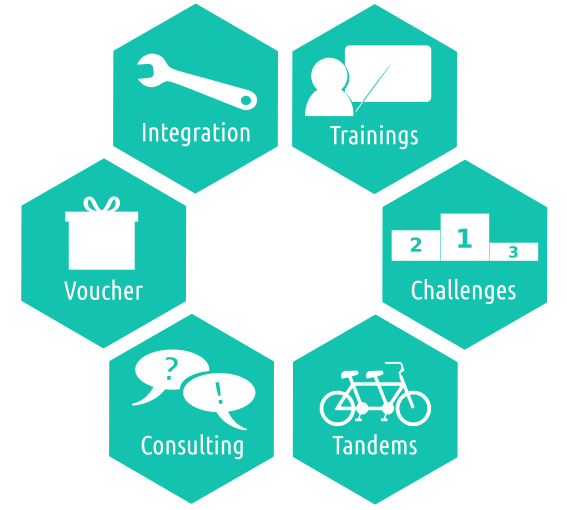
The event will be held from 10 AM to 5 PM, with DKZ.2R consultants on hand to discuss the project’s offers and applications. Don’t miss out on this exciting opportunity to discover how DKZ.2R is part of shaping the future of innovation.

For more information, visit the official Tag der Neugier website.

Event Details:

  • Time: Sunday, September 7th @ 10am - 5pm, 2025
  • Location: Forschungszentrum Jülich, 52428 Jülich
Related Posts

FDM-Werkstatt - Into the RDM-Toolbox!

FDM-Werkstatt - Into the RDM-Toolbox!

The Center of Data Litercacy (German: “Zentrum für Datenkompetenz”) DKZ.2R was officially launched mid November 2023. Already a month later we joined forces with fdm.nrw to organise the very first DKZ.2R-event (find the call for participation here). The “FDM-Werkstatt – Into the RDM-Toolbox” took place from March 18 to 20, 2024 at the IT Center of RWTH Aachen University. In total, 50 participants from all over Germany took part in the workshops. Many of them brought their own topics of interest with them and presented it in one of the 12 sessions. The contents of the sessions ranged from low-level introductions and RDM-basics to elaborate and in-detail coding sessions. For three days we worked together, discussed use cases and new RDM tools. But we also enjoyed the social program such as a tour of the AiX Cave and the server room of the ITC’s High Performance Computing Center. There was a good balance between cognitively demanding workshop sessions and more relaxing social events and lunch breaks which hopefully resulted in an enjoyable and rewarding experience for all participants. On the very last day of the workshop we offered a session to especially discuss ideas and directions for the DKZ.2R. The feedback we got in this session will help us in moving forward with the DKZ.2R and making a lasting impact for future researchers.

Read More
How To: Good Scientific Practice

How To: Good Scientific Practice

“Scientific integrity forms the basis for trustworthy research”, so it says in the Guidelines for Safeguarding Good Research Practice of the DFG, the German Research Foundation. As a major funder of research in Germany the DFG, as well as many other funders of research in Germany and the European Union, requires researchers to follow a certain set of rules conducting their research. These rules are called “good scientific practice” and have to be followed by researchers to be viable for funding. According to the guidelines researchers are required to “document all information relevant to the production of a research result as clearly as is required by and is appropriate for the relevant subject area to allow the result to be reviewed and assessed”. But good scientific practice is not done by documenting your research. It also includes i.a. protecting the personality rights of your subjects and handling research data in an appropriate manner by e.g. “back(-ing) up research data and results made publicly available, as well as the central materials on which they are based and the research software used, by adequate means according to the standards of the relevant subject area, and retain them for an appropriate period of time.” This is where Research Data Management (RDM) comes in. Of course RDM is much more than just creating a backup of your data on a USB-Stick and handing it over to anyone asking for it. “Good scientific practice” in RDM follows the FAIR principles:

Read More
A Survival Guide to Research Data Sharing Services in the Rhine-Ruhr Region

A Survival Guide to Research Data Sharing Services in the Rhine-Ruhr Region

A Survival Guide to Research Data Sharing Services in the Rhine-Ruhr Region

There are a lot of reasons why collaborating with other researchers on scientific projects is great! It provides new perspectives and gives you the chance to benefit from other people’s knowledge and input. When it comes to sharing and exchanging data across multiple locations and devices however, researchers are often disoriented and don’t know which tools, cloud services and so on are safe to share data in a secure and ethical way.

Read More