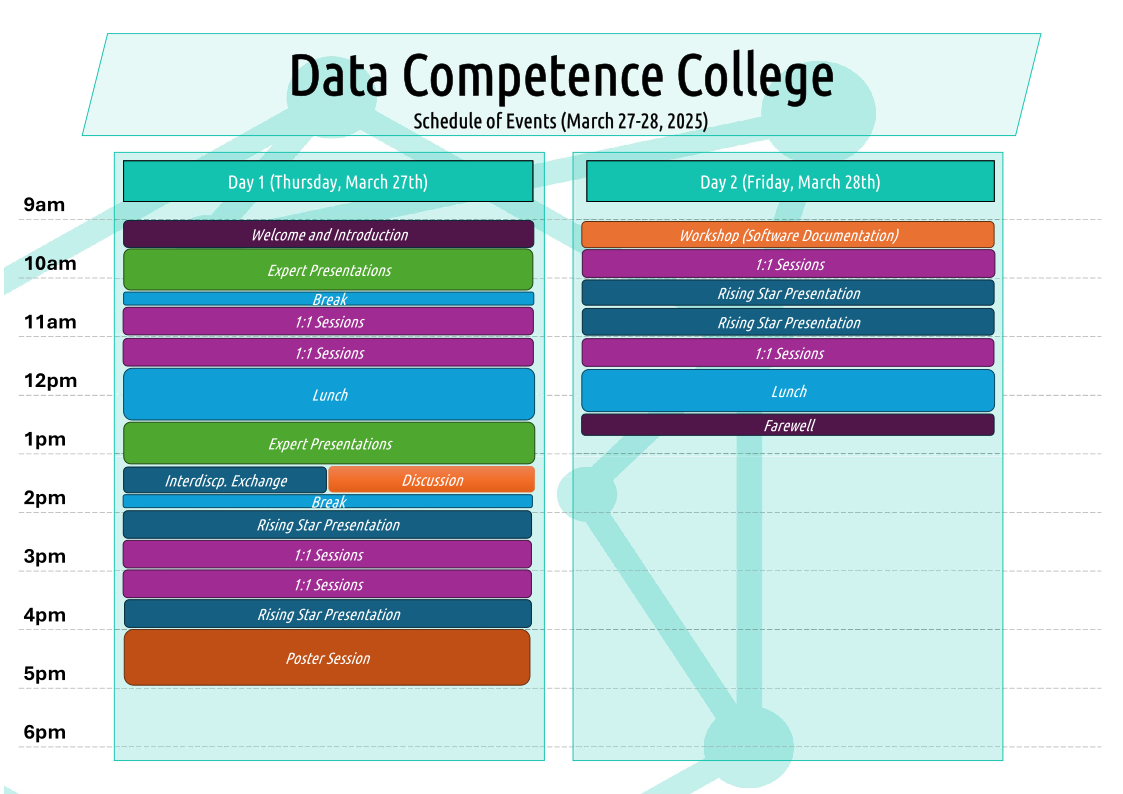
The first Data Competence College will be hosted from March 26th to 28th at the IT center of RWTH Aachen. Based on the concept of the Wissenschaftskolleg in Berlin or the Institute of Advanced Studies in Princeton, we have invited four individuals with high data competence from different scientific fields (“Data Experts”) as part of the data competence college.

As of now, Prof. Sebastian Houben from Hochschule Bonn-Rhein-Sieg (specialist in AI and autonomous systems), and Dr. Moritz Wolter from University of Bonn (expert in high performance computing and machine learning) have already confirmed their participation.

For three days we aim to create a space where local scientists, and especially early career researchers, can learn from the data experts and each other regarding research data and methods but also data experts can inspire each other. The schedule includes keynote presentations by all data experts, poster presentations by the participants, and 1:1 sessions between data experts and early career researchers, as well as a variety of method- and data-related workshops. We aim at creating an environment in which everyone feels safe to give input, share their knowledge and learn from the other participants and experts.

The exchange with and among experts from different disciplines and/or areas of focus in particular can provide new impetus for data processing or methodical data analysis. In this way, the DKZ.2R Data Competence College forms the focus of mutual enrichment participants and experts alike.

Event Details:

  • Time: Thursday, March 27th @ 9am - Friday, March 28th @ 1pm, 2025
  • Location: Kopernikusstraße 6, 52074 Aachen, Seminarraum 003 (Directions via OpenStreetMaps, Google Maps)

Schedule of Events: PDF Version | SVG Version | Plain Text
Related Posts

The Carpentries Workshop: Introduction to the Unix Shell, Git, and GitLab

The DKZ.2R presents, as a part of our “Trainings” work package, a Carpentries Workshop on the 18th and 22nd of November on the topic of “Introduction to the Unix Shell, Git, and GitLab”. This is an official Carpentries Workshop and will be hosted on-site at RWTH Aachen University.

Workshop material is available online and will be presented by official Carpentries instructors, who will guide you through the concepts with the help of hands-on exercises and personalized support. The course is designed for beginners and is open to participants from all domains. No prior knowledge is required. If you are interested in taking part in the workshop, you can sign up here.

Read More
How To: Good Scientific Practice

How To: Good Scientific Practice

“Scientific integrity forms the basis for trustworthy research”, so it says in the Guidelines for Safeguarding Good Research Practice of the DFG, the German Research Foundation. As a major funder of research in Germany the DFG, as well as many other funders of research in Germany and the European Union, requires researchers to follow a certain set of rules conducting their research. These rules are called “good scientific practice” and have to be followed by researchers to be viable for funding. According to the guidelines researchers are required to “document all information relevant to the production of a research result as clearly as is required by and is appropriate for the relevant subject area to allow the result to be reviewed and assessed”. But good scientific practice is not done by documenting your research. It also includes i.a. protecting the personality rights of your subjects and handling research data in an appropriate manner by e.g. “back(-ing) up research data and results made publicly available, as well as the central materials on which they are based and the research software used, by adequate means according to the standards of the relevant subject area, and retain them for an appropriate period of time.” This is where Research Data Management (RDM) comes in. Of course RDM is much more than just creating a backup of your data on a USB-Stick and handing it over to anyone asking for it. “Good scientific practice” in RDM follows the FAIR principles:

Read More
How To: Open Science

How To: Open Science

Tired of Recreating someone else’s work? - How Open Science can accelerate research and overcome reinvention

Have you ever found papers on algorithms but their implementation is missing? Found an interesting analysis but there is no way to check the results, as you don’t have access to the data they were derived from? Ever thought you had a great idea for a project, just to find out a year later that you are not the only research group following that specific idea? Not having access to other people’s code, data, metrics or even their plans for research projects often leads to unnecessary delays and scientific redundancies. There is an easy solution to overcome (almost) all of these issues. It’s called Open Science! What is Open Science? The UNESCO defines Open Science as a construct of “movements and practices aiming to make multilingual scientific knowledge openly available, accessible and reusable for everyone, to increase scientific collaborations and sharing of information for the benefits of science and society, and to open the processes of scientific knowledge creation, evaluation and communication to societal actors […]”. To ensure that everyone has access to scientific knowledge and infrastructure, Open Science focuses on four main concepts.

Read More