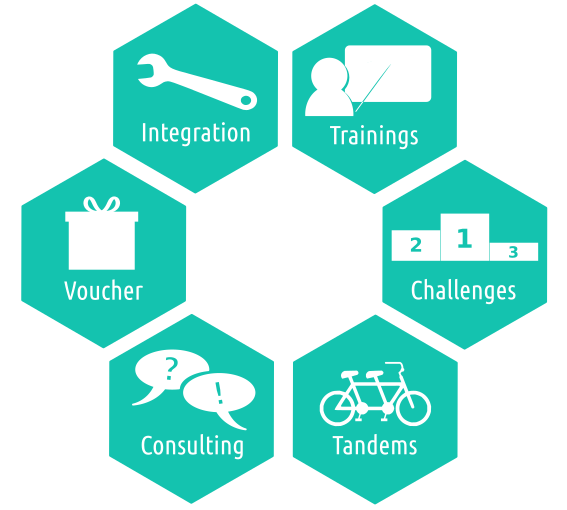
As part of our “Trainings” work package, the DKZ.2R creates, curates and presents a variety of free trainings, seminars and courses. Our next offering will be a one and a half day carpentries-style workshop on basic machine learning using python and scikit-learn, to be presented at RWTH Aachen University on 24th and 25th of July, 2025. The workshop will cover the following topics:

  • What is Machine Learning / Why bother?
  • Supervised Methods (Regression / Classification)
  • Ensemble Methods
  • Unsupervised Methods (Clustering / Dimensionality Reduction)
  • Neural Networks
  • Ethics and Implications of Machine Learning

Workshop material is available online and will be presented by instructors who will walk you through the steps and are available for questions throughout the event. If you are interested in taking part in the workshop, you can sign up here.

All workshop material is also available online on GitHub: Link to repository

A basic familiarity with Python is expected, including writing for loops, conditional statements, using functions, and importing libraries.

  • Title: Introduction to Machine Learning with Python and Scikit-Learn
  • When: Wednesday, July 24th (9am-5pm) & Thursday, July 25th (9am-3pm)
  • Where: RWTH Aachen University, Germany (Kopernikusstraße 6, 52074 Aachen, Seminarraum 003)
  • Format: This workshop in In-Person and no remote or online attendance options are currently planned.
Related Posts

Data Competence College II

The second DKZ.2R Data Competence College will be hosted from November 24th to 26th at the IT center of RWTH Aachen. Based on the concept of the Wissenschaftskolleg in Berlin or the Institute of Advanced Studies in Princeton, we have invited individuals with high data competence from different scientific fields (“Data Experts”) as part of the data competence college.

Data Experts:

Prof. Julian Kunkel, and Prof. Bodo Winter confirmed their participation as Data Experts for the second Data Competence College.

Read More

Hackathon DKZ.2RxQUADRIGA

On May 8th, the Data Literacy Centers DKZ.2R and QUADRIGA are teaming up for a hackathon on the topic of text-corrections using LLM’s.

This will be an internal event for members of the Data Literacy Centers DKZ.2R and QUADRIGA.

The Data Literacy Center QUADRIGA is primarily focused on creating high-quality educational resources for the digital humanities. In our hackathon we will work on a use casedealing with historical texts from the time of the spanish flu. Channelling our resources and competencies will not only help us to strengthen the connections between our two Data Literacy Centers but will also provide us with a use case on how to use LLMs for the post-correction of automatically recognized historical texts which can be used for training purposes such as Data Challenges and Workshops in a variety of different domains.

Read More
How To: Good Scientific Practice

How To: Good Scientific Practice

“Scientific integrity forms the basis for trustworthy research”, so it says in the Guidelines for Safeguarding Good Research Practice of the DFG, the German Research Foundation. As a major funder of research in Germany the DFG, as well as many other funders of research in Germany and the European Union, requires researchers to follow a certain set of rules conducting their research. These rules are called “good scientific practice” and have to be followed by researchers to be viable for funding. According to the guidelines researchers are required to “document all information relevant to the production of a research result as clearly as is required by and is appropriate for the relevant subject area to allow the result to be reviewed and assessed”. But good scientific practice is not done by documenting your research. It also includes i.a. protecting the personality rights of your subjects and handling research data in an appropriate manner by e.g. “back(-ing) up research data and results made publicly available, as well as the central materials on which they are based and the research software used, by adequate means according to the standards of the relevant subject area, and retain them for an appropriate period of time.” This is where Research Data Management (RDM) comes in. Of course RDM is much more than just creating a backup of your data on a USB-Stick and handing it over to anyone asking for it. “Good scientific practice” in RDM follows the FAIR principles:

Read More