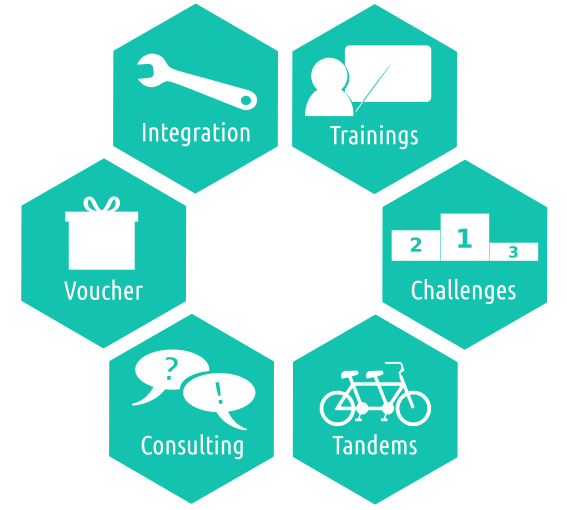
As part of our “Trainings” work package, the DKZ.2R creates, curates and presents a variety of free trainings, seminars and courses. Our next offering will be a one day carpentries-style workshop on intermediate python, to be presented at RWTH Aachen University on the 19th of September, 2025. The workshop will cover the following topics:

  • Virtual Environments
  • Classes and Object Oriented Programming
  • Inheritance and Composition
  • Creating a Python Module
  • Static Code Analysis
  • Unit Testing
  • Publishing a python package

Workshop material is available online and will be presented by instructors who will walk you through the steps and are available for questions throughout the event. If you are interested in taking part in the workshop, you can sign up here.

All workshop material is also available online on GitHub: Link to repository

  • Title: Intermediate Python Topics
  • When: Friday, September 19th (9am-5pm)
  • Where: RWTH Aachen University, Germany (Kopernikusstraße 6, 52074 Aachen, Seminarraum 001)
  • Format: This workshop in In-Person and no remote or online attendance options are currently planned.
Related Posts

How To: Good Scientific Practice

How To: Good Scientific Practice

“Scientific integrity forms the basis for trustworthy research”, so it says in the Guidelines for Safeguarding Good Research Practice of the DFG, the German Research Foundation. As a major funder of research in Germany the DFG, as well as many other funders of research in Germany and the European Union, requires researchers to follow a certain set of rules conducting their research. These rules are called “good scientific practice” and have to be followed by researchers to be viable for funding. According to the guidelines researchers are required to “document all information relevant to the production of a research result as clearly as is required by and is appropriate for the relevant subject area to allow the result to be reviewed and assessed”. But good scientific practice is not done by documenting your research. It also includes i.a. protecting the personality rights of your subjects and handling research data in an appropriate manner by e.g. “back(-ing) up research data and results made publicly available, as well as the central materials on which they are based and the research software used, by adequate means according to the standards of the relevant subject area, and retain them for an appropriate period of time.” This is where Research Data Management (RDM) comes in. Of course RDM is much more than just creating a backup of your data on a USB-Stick and handing it over to anyone asking for it. “Good scientific practice” in RDM follows the FAIR principles:

Read More

Spring School 2025 in Aachen – Research Data Management in Materials Science and Engineering

Enabling a consistent and unobstructed standardization of research data will lead to substantial improvements in efficiency and synergies/collaboration among individual researchers and well-designed IT systems. In the era of digital infrastructures, this measure holds paramount importance in shaping the future of research. For the data to be sustainable and reusable, it must adhere to the “FAIR Data Principles”, meaning it should be “Findable, Accessible, Interoperable, and Re-usable”. The FAIR principles will be a cornerstone of the European Open Science Cloud (EOSC) implementation. Nowadays, Data Management Plans (DMPs) have become a requirement for project applications in Horizon Europe and are increasingly being demanded by various funding organizations, including the German Science Foundation (DFG), among others. The scientific consortium NFDI-MatWerk (National Research Data Infrastructure) focuses on the research area Materials Science & Materials Engineering (MSE). The central challenge is the digital representation of materials and their relevant process and load parameters. NFDI-MatWerk will provide in this summer school tailored information and solutions for dealing with research data in MSE.

Read More

Data Competence College II

The second DKZ.2R Data Competence College will be hosted from November 24th to 26th at the IT center of RWTH Aachen. Based on the concept of the Wissenschaftskolleg in Berlin or the Institute of Advanced Studies in Princeton, we have invited individuals with high data competence from different scientific fields (“Data Experts”) as part of the data competence college.

Data Experts:

Prof. Julian Kunkel, and Prof. Bodo Winter confirmed their participation as Data Experts for the second Data Competence College.

Read More