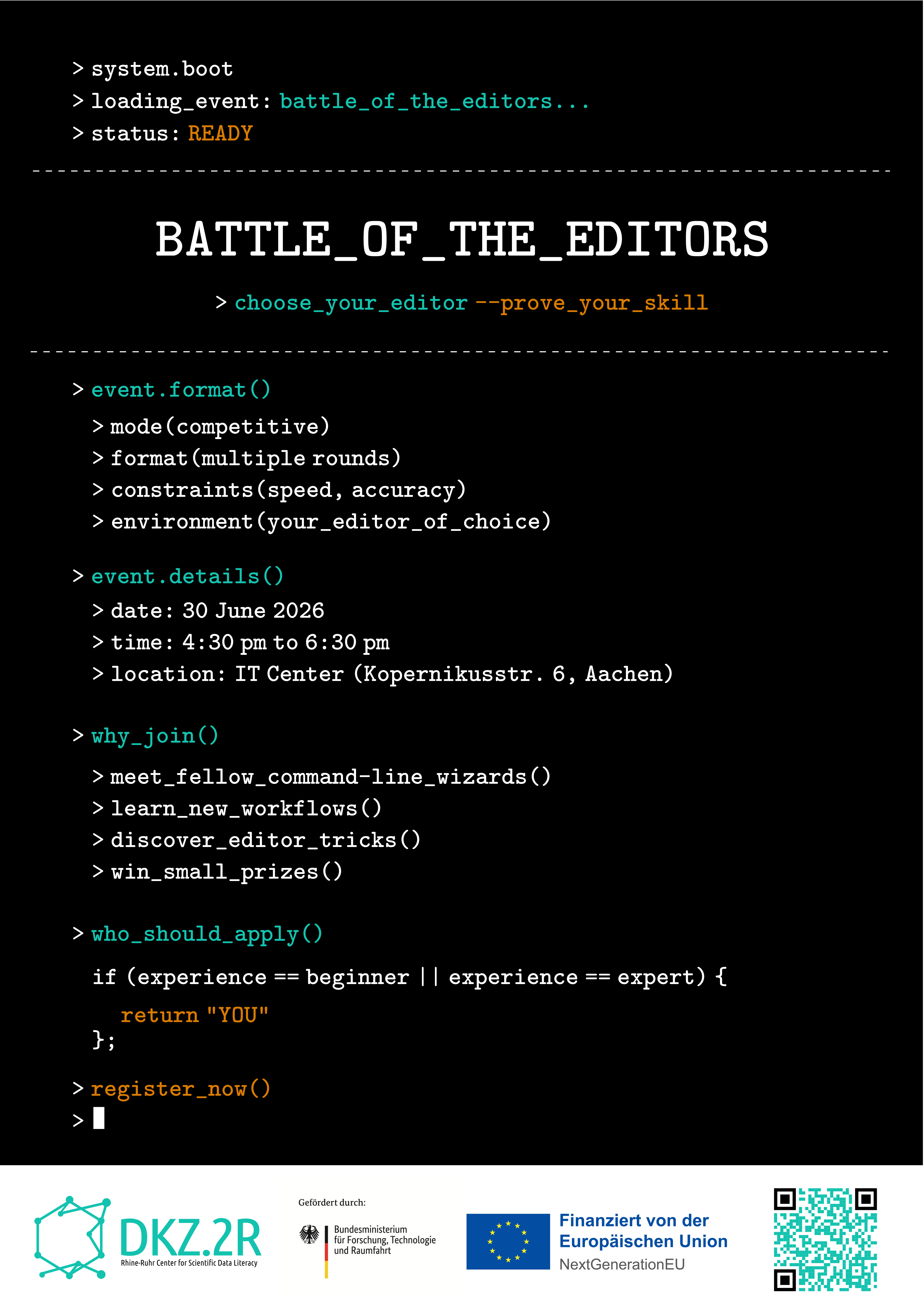
This is a fast-paced, playful competition in which participants use their editor of choice to complete a series of data and text challenges as quickly and accurately as possible. Whether you swear by Vim, live inside Emacs, prefer a modern IDE, or rely on OpenRefine for data wrangling — bring your setup and prove your skills.

Battle of the Editors

Detail Information
Date Tuesday, June 30, 2026 | 4:30 PM – 6:30 PM (Immediately following the opening of the hackathon)
Location Aachen, Seffenterweg 23 / Kopernikusstr. 6 (IT Center)
Attendance Free to attend | Open to all hackathon participants and guests
Registration To help us plan the event please sign up using this form

Why join?

  • A fun and low-stakes way to meet fellow participants before the hackathon
  • Learn new tricks from other editors and workflows
  • Small prizes for the top teams
  • Great opportunity for beginners to get a first taste of Wikidata editing in a supportive setting

May the best editor win

Before the hackathon "Archaeoanalysis of Metadata Processing" kicks off in earnest, we are warming up with a head-to-head showdown: Battle of the Editors.

Format

The Battle runs in three rounds, in which the teams have to manage various tasks using their editor of preference.

Who should come?

Everyone! You do not need to participate in the main hackathon to join the Battle of the Editors. Whether you are a seasoned command-line wizard or just curious about how others wrangle data, you are very welcome.

The Battle of the Editors is a satellite event of the Archaeoanalysis of Metadata Processing Hackathon.
To help us plan the event please: Register for the event
Event Poster

Related Posts

Do's and Don'ts in Research Data Management

Do's and Don'ts in Research Data Management

Research Data Management Do’s and Don’ts - Step up your RDM skills!

1. Structuring and naming your folders There is an easy way to make your data findable for you and your team: establish a folder structure which makes sense for you and your working group as well as naming conventions for your folders.

Don’t:

Paul and Suzie
»Guideline
>application
»version2_final
»v.3
»review
»3rd.version
>JD
»qn
»0-1

Instead do:

000_int_orga
»01_application
»02_review 120_questionaires
»01_qualitative »02_quantitative 130_data
»01_qualitative »02_quantitative

Read More
A Survival Guide to Research Data Sharing Services in the Rhine-Ruhr Region

A Survival Guide to Research Data Sharing Services in the Rhine-Ruhr Region

A Survival Guide to Research Data Sharing Services in the Rhine-Ruhr Region

There are a lot of reasons why collaborating with other researchers on scientific projects is great! It provides new perspectives and gives you the chance to benefit from other people’s knowledge and input. When it comes to sharing and exchanging data across multiple locations and devices however, researchers are often disoriented and don’t know which tools, cloud services and so on are safe to share data in a secure and ethical way.

Read More
Comments on Collaboration - My Experience with the DKZ.2R Rent-an-Expert Program

Comments on Collaboration - My Experience with the DKZ.2R Rent-an-Expert Program

Comments on Collaboration - My Experience with the DKZ.2R Rent-an-Expert Program

At the beginning of this year (2025), I received an email regarding the DKZ.2R “Rent an expert” program. I was very interested in this initiative and therefore applied for support from the scientific consulting team at the Rhine-Ruhr Center for Scientific Data Literacy (DKZ.2R) for assistance with my data analysis.

I obtained my master’s degree in Plant Nutrition from the China Agricultural University and pursued my PhD study at the University of Hohenheim. I am currently a postdoctoral researcher in the Institute of Crop Science and Resource Conservation, Crop Functional Genomics, at the University of Bonn.
My research expertise includes plant culturing, molecule cloning, biochemical analysis and limited data analysis experience on large-scale NGS datasets.
Since the beginning of April 2025, two DKZ.2R consultants were assigned to me: Tarek Iraki, who is proficient in programming languages such as Python, and Lennard Maßmann, who specializes in working with R. Together, we collaboratively worked on my Postdoctoral project, which focuses on the molecular and genomic dissection of lateral root development in maize.

Read More